Have you ever experienced the excitement of your rally car jumping over a crest? Or the awful feeling when the rear end slides out on the gravel? Rally sim racing is a lot of fun, but there’s a difference when you are sitting in your gaming chair. This is where motion platforms come into play.
Do these expensive moving setups actually make you quicker? Let’s find out.
What’s the Big Deal About Motion?
To put it simply, rally driving is about feeling. In rally driving, feeling comes from the car as it slides around corners. Through a sophisticated static sim, you can “see” everything the car is doing. However, you can’t feel everything the car is doing.
Motion systems attempt to fill this void by shaking, tilting, bumping, and moving your seat to simulate the rally car in the game. If a virtual car slides, you will feel a slide. If the car runs over a bump, your seat will rise and fall.
Mark Higgins, a professional rally driver, describes the feeling as shocking. He has even stated, “You start reacting to the car before you even see the slide on screen.”
Types of Motion Rigs
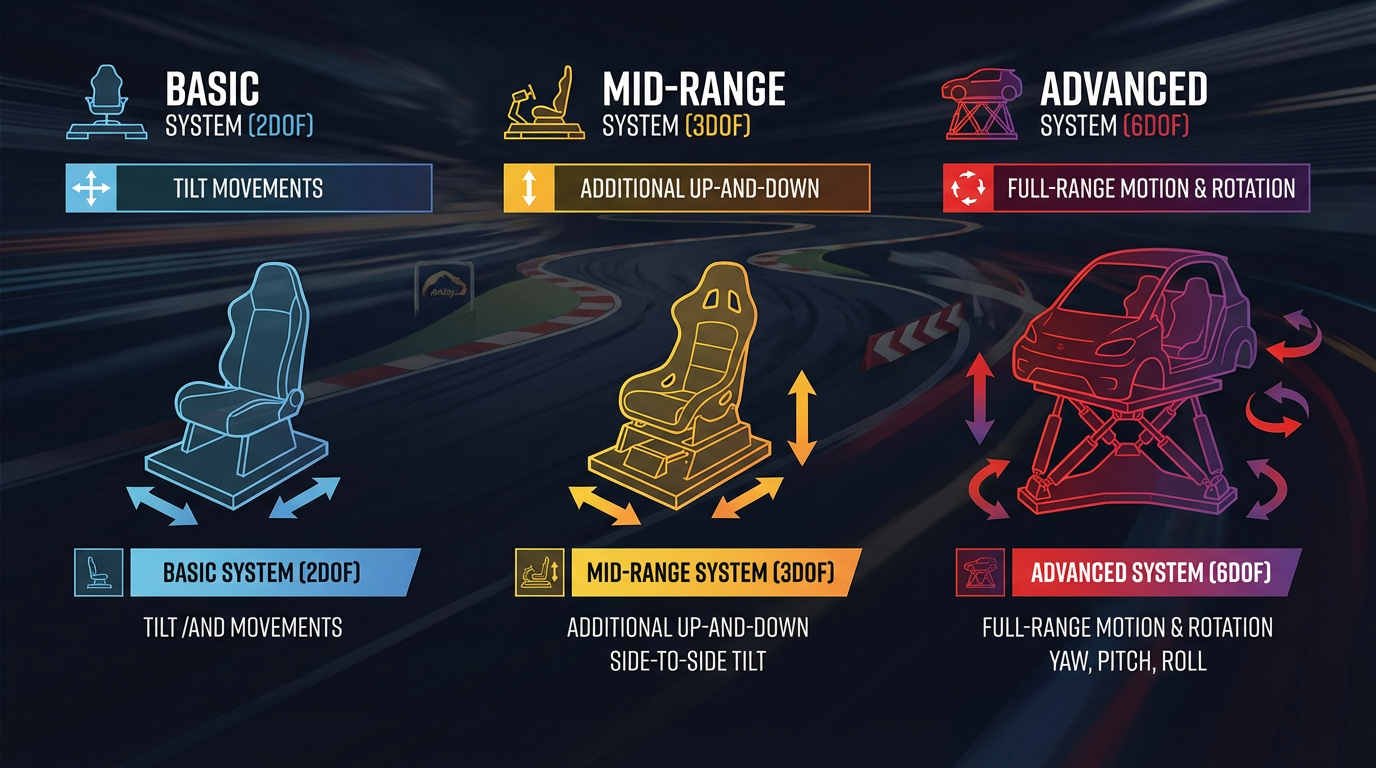
There are different types of motion systems. The most basic ones (2DOF) only tilt forward and backward, and side to side. Adding more movement, mid-range systems (3DOF) can include up-and-down motion. The more advanced systems (6DOF) can move in any direction and even rotate.
As you can imagine, systems with more movement are also more expensive. A basic system can start around $1,500, but you can spend over $20,000 for a full-motion rig. That’s a lot!
But Do They Make You Faster?
This is what matters most. Studies from racing schools and sim labs give us some answers:
Drivers learn tracks faster with motion feedback. Your brain processes physical cues more quickly than visual ones.
Your reaction time can improve by up to 0.2 seconds. That doesn’t sound like much until you consider you are avoiding crashes at 100mph!
Your tire grip limits become more apparent. You feel when you are pushing too hard.
The Science Behind It
The human brain loves consistent input, and when the eyes say “we’re sliding,” and the body feels no movement, it gets confused. Motion platforms sync these signals and help your brain build better driving habits.
Dr. David Ferguson from Michigan State University found that drivers using high-quality motion rigs showed brain activity patterns much closer to those in real-world driving than those using static setups.
Real Drivers, Real Results
Oliver Solberg, a WRC Rally Champion, gets motion rig training between events. “I can practice new stages with no travel or risk. The muscle memory transfers directly to the real car.”
And it’s not just elite drivers. After three months of practice on a motion sim, amateur rally driver Sam Burton improved his first real stage time by five seconds! That’s massive!
The Not-So-Great News
Motion platforms are not magic:
- Bad systems can teach bad habits. If the motion feels fake or delayed, you’ll learn to adjust your timing.
- They take up tons of space.
- They’re loud.
Who Should Invest?
Motion platforms make the most sense for:
- Serious rally drivers who need extra practice time
- Sim racers who compete at high levels
- Rally schools teach newbies the basics of car control
- People with extra cash who want the coolest setup on the block
For casual players, you need to save your money and spend it on better pedals and a wheel first.